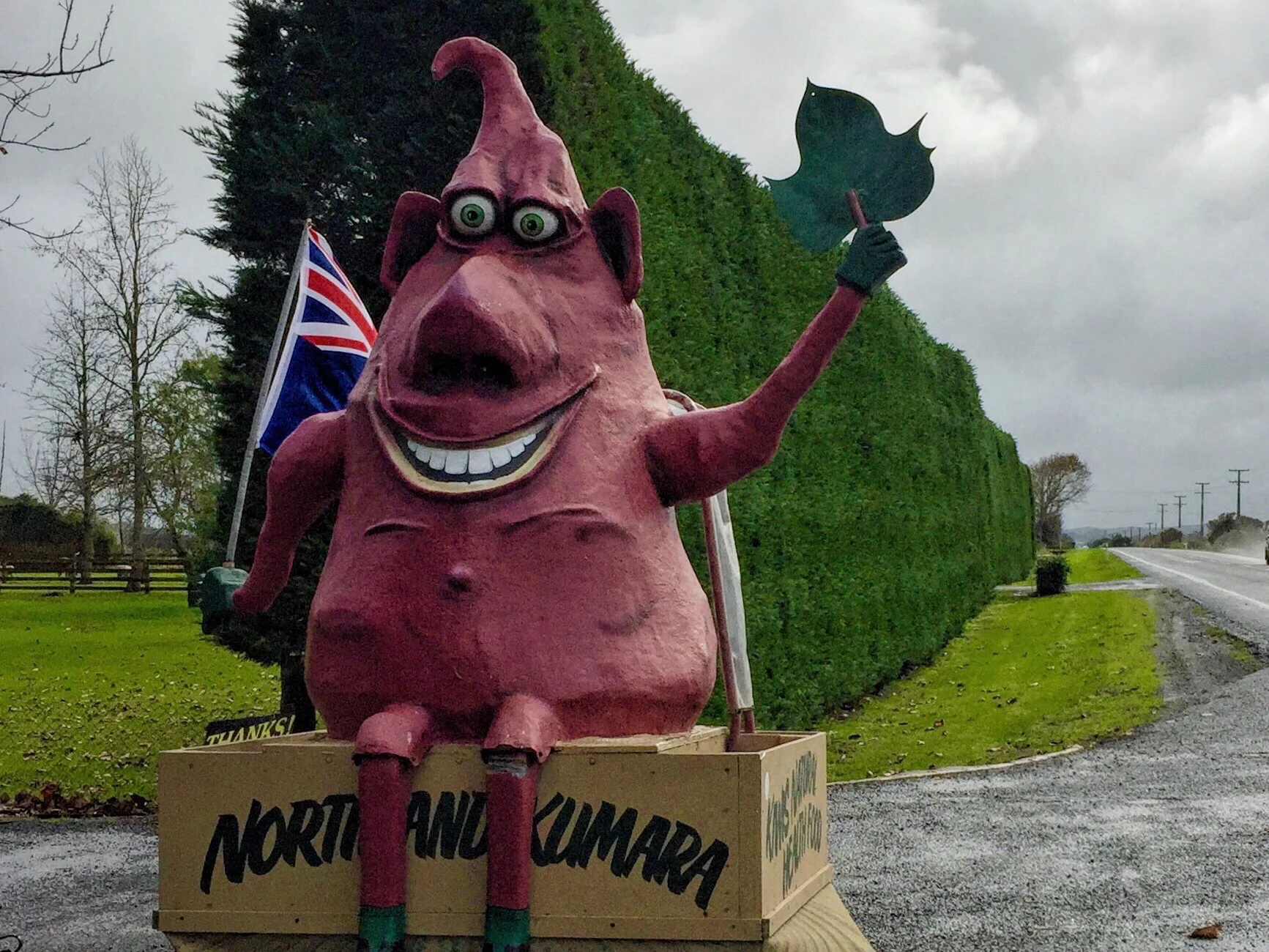
Travelling northern roads, you’ll pass the signs along the highway, there’s kūmara all around. Definitely worth a stop. It’s our own sweet potato, loved by locals and a treat for visitors to our country. Tremendous to see it lining the roadside, travelling in the north of the north.
Our own sweet potato
The kūmara’s large, starchy, sweet-tasting, tuberous roots make it a root vegetable. And it’s native to tropical regions in the Americas. The kūmara’s only distantly related to the potato. And it’s definitely not a yam.
Around the world it’s known as "sweet potato", "patate douce”, ”hong shu" (红薯) and "khoai lang”. But our New Zealand version is quite distinctive and known by its Māori name, kūmara.
A legend of arrival
We’ve read conflicting accounts of the kūmara's arrival here.
Some say, in about the 10th century, Kupe brought the kūmara here from Hawaiki. Other reports tell that, during the migration around the 13th century from Polynesian islands, several important Māori food plants arrived. The kūmara proved the most successful of those, maturing quickly and thriving in Northland’s light sandy soils.
And so, to pre-European Māori, it was the most valuable cultivated food.
The main modern variety, red-skinned Owairaka Red, originated in a cultivar introduced here in the 1850s, a larger South American variety brought on whaling ships. It’s now about 75% of our kūmara crop.
A few types
And now, on New Zealand northern road trips, you’ll find plenty of varieties, but three main varieties commercially available.
Most common is the Owairaka Red, with a creamy purple-streaked white flesh and mellow flavour. Then there’s gold, sold as Toka Toka Gold, with golden skin and flesh, and a sweeter taste than red. And the third’s orange, Beauregard, with a rich orange flesh, sweeter than red and gold.
So, for sweet, sweet potato, go for orange.
Dargaville’s the place
And it’s in the sub-tropical north, near Dargaville, that you’ll find the best place to see them growing. Nearly 95% of our total crop comes from the Kauri Coast, due to rich soil and warm temperatures. Growing the humble sweet potato’s huge industry in the Kaipara, providing hundreds of jobs. Much to our delight.
And so, on this kūmara highway road trip, you’ll see the most kūmara signage anywhere in the world. It’s the kūmara capital of the world. Undisputed.

While you’re passing in this area, you won’t miss views of the imposing Wairoa River and the impressive Tokatoka Peak. Much of nature to see along this northern west coast heading north or south to or from the Hokianga, where more food treasures abound.

To the makeshift kitchen
There’s a lot to do with them, and lots beyond a traditional cook in a hāngi earth oven, as kūmara chips or fries, or as a key part of roast meals, with meat, potatoes and pumpkin. For a current favourite, try a kūmara gratin.
Your road trip companion…
To find more on The FoodPath NZ’s handpicked eateries and food producers, and our collection of other spot on New Zealand food moments, to check out on your next New Zealand trip - including what’s good to know on where we headed to on our road trip along the kūmara highway, in and around Dargaville and to or from further north, and other special spots nearby - you’ll find The FoodPath NZ guide (for mobile) here.