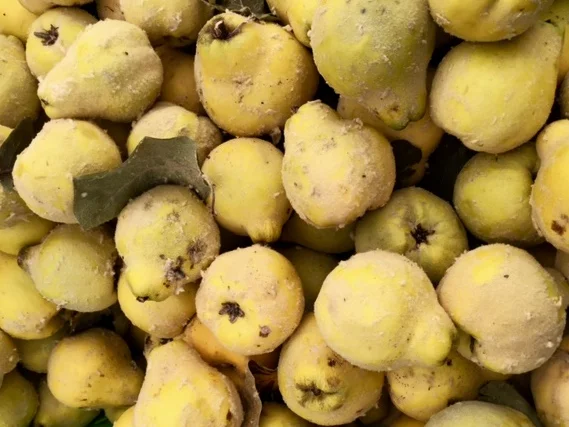
The old-fashioned quince, slowly poaching in spices and sweet syrup, offers a true autumn fragrance. It is a favourite dessert, but also a delicious start to the day, keeping to the autumn season, with porridge.
But the fragrance is there in the fruit even before the poaching begins. It has a soft perfume, rose-like, vanilla, citrus and apple, and honey, too. The quince is a pretty unusual fruit. So what, other than its perfume, do we know of it?
A rose relation
Quince is one of the earliest-known fruit, a member of the rose family, and related to the apple and pear. It has a tremendous shape, with generous curves prompting, we have read, a description of voluptuousness.
And yet, for all its beauty, it’s a pretty under-used fruit, perhaps for the simple reason that it is usually hard to find and impossible to eat in its raw state. Its flesh is hard and sour. But cooking softens the flesh, and transforms the taste to a cross between its apple and pear relations.
Not to be confused with apples
Quince trees originated, we have read, in the Caucasus region, on the edge of Turkey, Iran and Russia. They preceded apple and pear trees. And so the "apples" referred to in the story of Adam and Eve, and in the Song of Solomon, were almost certainly quinces. (Perhaps it is, more correctly, “Adam’s quince”, then...)
Greek mythology associates the quince with Aphrodite, the goddess of love. In classical legend, it's the fruit of love, marriage and fertility. Many believe that the golden apple of Hesperides (which Paris gave to her in the Greek myth of events that led up to the Trojan war) was also a quince.
Old-fashioned and extra-special
Quince is often described as an old-fashioned fruit, including by us right here. It’s pretty uncommon to find in our supermarkets, as New Zealand does not have a large commercial producer. And the season is limited.
But, in a way, that makes quince extra-special when you do discover them.
They are in many home gardens, particularly in older streets. And you can find them in speciality food stores, farmers’ markets, or even roadside in rural areas. Quince is ripe and ready for eating around now, late autumn - in New Zealand, the season is generally April to June.
It’s a fruit that loves hot, dry situations, in keeping with its eastern origins where it thrives in rocky soils and conditions - not unlike those of our own Central Otago, North Canterbury and Marlborough.
Cooking transforms them
Then, once you do find a quince, it will have a pale down covering the skin, like a peach, only heavier. The fluff protects the young fruit, so needs to be rubbed off before cutting. And it sure is tough to cut, hard to slice in half, and even worse to core.
So the quince is hard, acidic, and astringent before cooking. But, once cooked and sweetened, it turns pinky red and tastes of autumn. It’s probably best known as a rose-coloured jelly or thick paste (membrillo in Spain). It makes a tremendous paste to serve with hard cheese, and it’s also full of natural pectin, so no need to add extra pectin to make quince jelly. Indeed the term "marmalade", originally meaning a quince jam, derives from "marmelo," the Portuguese word for quince.
And cooking, poaching or baking, does transform the quince. It needs to be cooked long and slow, for quite some time, so that the pectin breaks down and the hard, pale flesh then changes to a rich, red delight. Then, when you poach, the quince becomes not just edible, but delicious: sweet, delicate, fragrant.
Fragrant and feasting
It’s the fragrance we keep returning to. One suggestion we have read says it would be crazy to to cook quinces as soon as you bring them home. Instead, keep them for a few days on a platter somewhere, as a natural home fragrance.
And some will know the lines of Edward Lear’s poem, describing the wedding feast of The Owl and the Pussycat:
They dined on mince and slices of quince, which they ate with a runcible spoon;
And hand in hand on the edge of the sand, they danced by the light of the moon.
We’re not sure about a combination with mince (fruit, or otherwise), but we can recommend slices of quince, preferably poached in some fragrant syrup. And, for an idea of what to do with all that delicious poaching syrup, click here.