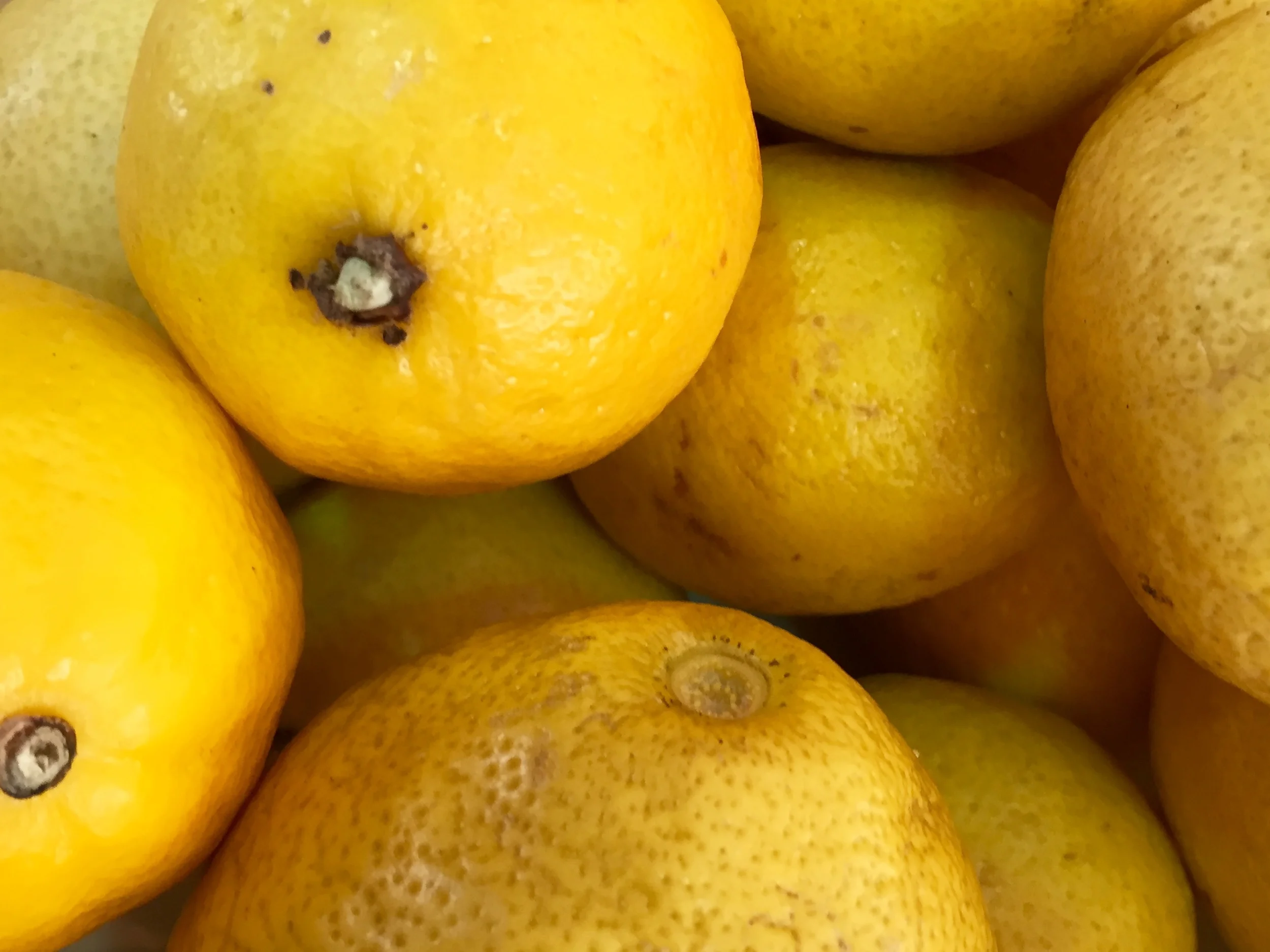
You can’t beat starting the day with the juice of half a lemon squeezed into a bit of hot water. Using great lemons, it tastes good, it feels good for you, and it smells great.
So, as the first real food we see pretty much every morning, and one that often ends up in just about every meal one way or another, we started thinking about lemons just a little more…
The backyard tree
You are very likely to know of an old lemon tree in someone’s back yard, perhaps your own. Citrus trees really are a kiwi backyard classic. We’ve looked into this phenomena, but cannot find any special reason for it. Other than, of course, the obvious: they are incredible survivors, reliable fruiters, and hugely practical for all sorts of cooking (and for that matter their juice is quite handy for cleaning).
But in spite of their reliability, for some reason, this year our backyard lemon tree did not look its usual vibrant, and fruitful, wintery self. There’s been a few fruit, but not the usual bucket loads. Precisely why it seems likely to be taking a break this year is an unsolved mystery - all the other citrus look in good shape. But as proponents of having a bit of time out every now and again ourselves, it doesn’t seem fair to complain too much.
It has meant that we have had to turn to buying lemons, in order to have what has become very much a kitchen staple close to hand. And, of course, winter is coming to a close, so many citrus trees are ending their fruiting season.
So what is the waxing about?
This led to a question - what is with the “waxing” on many lemons that you see commercially available?
The answer appears to be that they are coated with an edible wax which is designed to slow moisture loss, and improve shelf life.
So if you don’t happen to have a tree handy (or your handy tree is taking a bit of time out or it is not fruiting season (autumn/winter)), and you would prefer unwaxed lemons, a farmers market would be the place to look. Another possibility is to have a go at removing the wax off bought lemons by boiling the jug and pouring it briefly over them, them giving them a scrub under cooler water with a clean scrubbing brush. Over to you…
A truly international fruit
We think lemons are an almost universal, international and totally versatile fruit. While New Zealand has its fair share of lemons, we have read that they were first established in the Indian/Pakistani regions - as a hybrid of the “citrus originals” - and from there spread through the temperate zones of the world.
All citrus come from the same original parentage. They are, in some shape or form, apparently a hybrid of citron, mandarin, pomelo and papeda (whatever these may be). We’ve read different views on exactly which combinations make up today’s lemon… Suffice to say, in spite of its ubiquity nowadays, it wasn’t the first kid on the block. Indeed, one of our mainstay lemons - the Meyer - is an early 20th century Californian creation, apparently a cross between a “true” lemon and an orange or mandarin. Well, who knew!