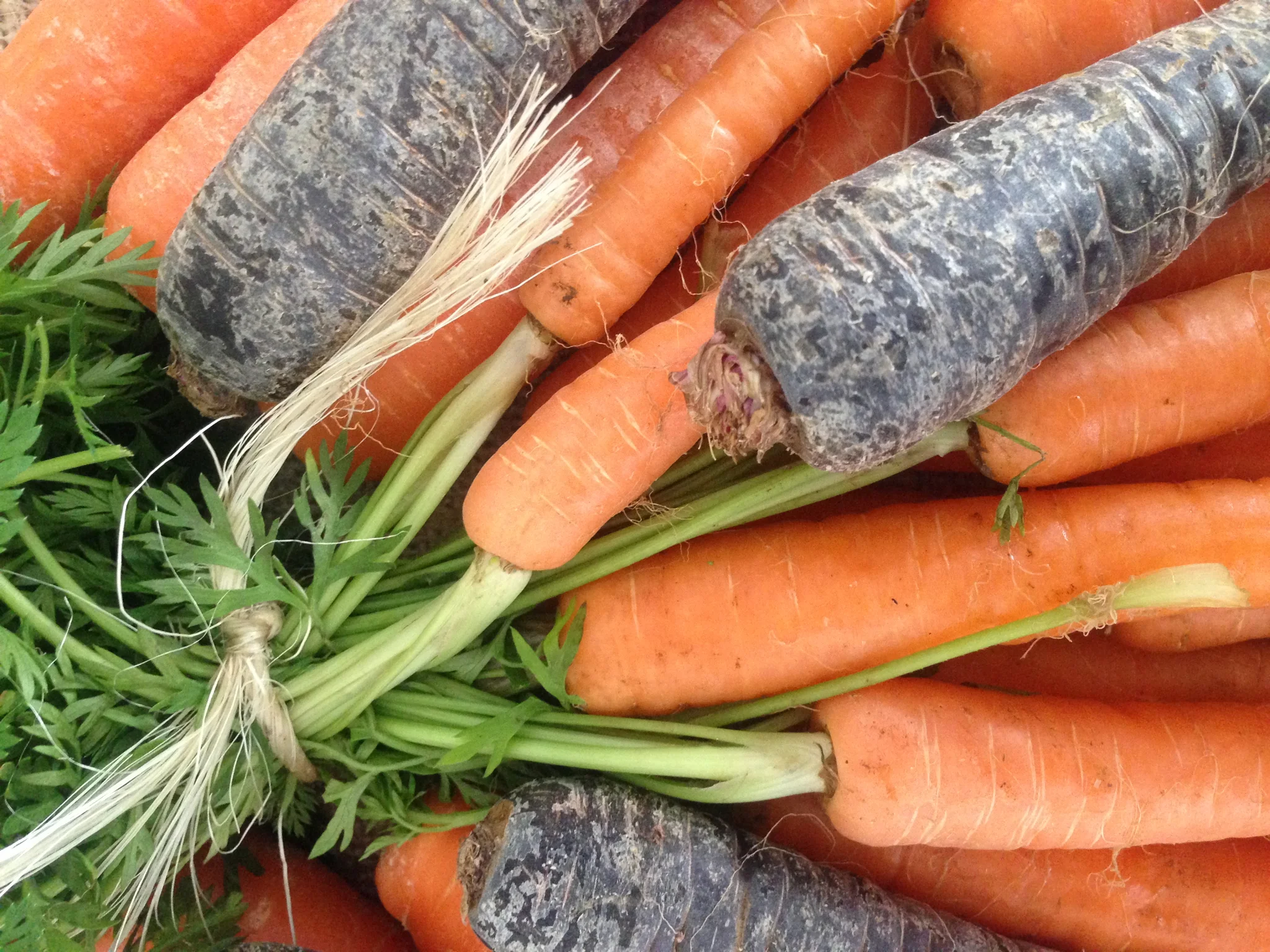
Carrots are often thought of as an ultimate health food. We were probably all told as children to "eat your carrots" and they will help you see in the dark.....what's the truth to all that?
Hold that thought - we'll come back to that, but first to the carrots we enjoy today.
One year or two
Carrots belong to the Umbelliferae family of plants, along with parsley, celery and dill. They are biennial plants, living for two years. They produce and store sugars during the first year of growth in single large roots, called taproots. Then they use the stored sugars to produce flowers and seeds in the second year. But flowers and seeds are not often seen in home gardens - as we usually harvest them in their first year of growth.
A lot of British propaganda
And what about that eyesight advantage: any truth to that claim? Well it turns out the science is pretty sound - that carrots, by virtue of their heavy dose of vitamin A (in the form of beta carotene), are pretty good for your eye health. But, somewhere along the way, the message that carrots are pretty good for your eyes changed into a message that carrots improve eyesight. And one explanation for that message is British propaganda from World War II.
During World War II, German airplanes flew in darkness, and the British government issued citywide blackouts. The Royal Air Force was able to repel the German planes with the use of new and secret radar technology. But, to keep that technology secret, the Ministry of Information told newspapers that the reason for the success was that the RAF pilots ate an excess of carrots. And the British public generally believed that eating carrots would help them see better during the citywide blackouts. Advertisements appeared: "Night sight can mean life or death" and "Carrots keep you healthy and help you see in the blackout”.
New Zealand's carrot town
We'll leave you with a true New Zealand carrot fun fact. You can't miss it if you drive through the town: the famous six-metre high carrot in the central North Island town of Ohakune was built in 1984 to commemorate the pioneering work of early Chinese market gardeners - producers of our carrots, potatoes, parsnips, brussel sprouts, cabbage, cauliflower, and swedes. That extremely large carrot reminds us of the importance of market gardening to that local economy. And so the importance of carrots to our New Zealand tables, and (eye and other) health…..