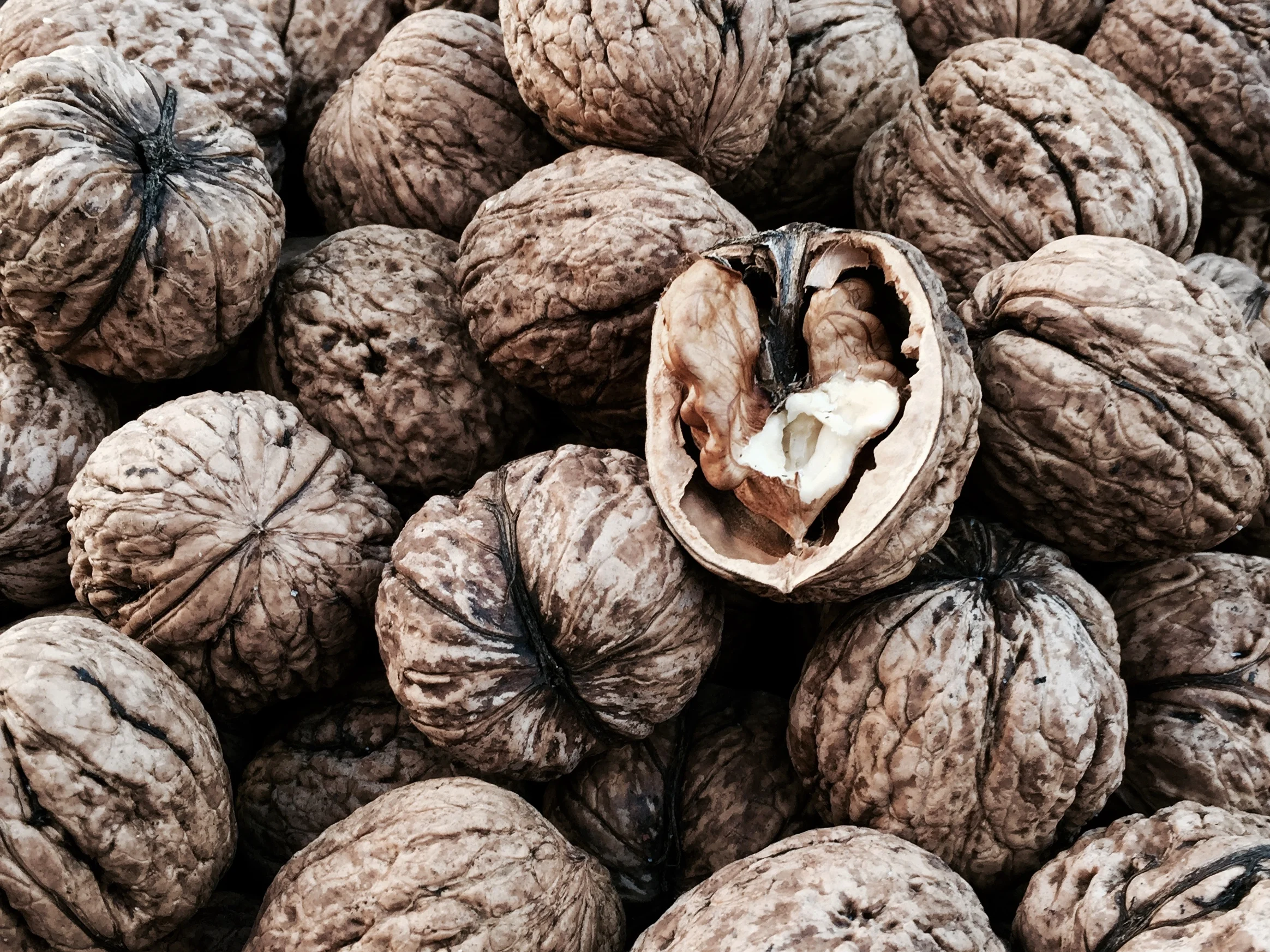
The air has cooled a little, and we are heading towards autumnal salad days… where days are still warm and clear, and it is just too much of a wrench to look beyond salad greens to full-on winter veg.
And it is on these very days that walnuts come to the fore, adding substance and punch to changing season salads. They are model siblings with other autumnal favourites: pears, apples, beetroot. And, we found out, they are the second most popular nut in the world, after almonds. So it is time to crack open a look into these magnificent looking nuts.
Coming into season
Walnuts are harvested in autumn. Around now, they start falling from the tree, and can be collected from the ground.
But what many of us won’t be used to seeing is the green husks that surround the walnut shells. Those husks split when the nut is ripe, allowing the nut to drop for harvesting, which is followed up by a drying process taking a few weeks. So this season’s walnuts will come to market around the start of winter.
Where are they from?
Our walnuts are of Persian descent (although archaeologists might debate this). They were traded along the Silk Route between Asia and the Middle East, eventually spreading their popularity around the world.
More recently, walnuts are often classified as “English” or “American”. The English ones are those of Persian origins - English merchants ate and carried them on their ships. And these are the ones that ended up in New Zealand, brought here by English and French settlers.
Black walnuts have American roots. They are much harder to crack - requiring, for example, driving a car back and forth over them in the driveway... taking care not to stain your driveway (the husks are used to create dark dyes).
Even we would say that the familiar Persian / English varieties can be a little tricky to open. But it is precisely because of that hard shell that walnuts will keep in the right conditions - as the nut is well protected from light, heat and moisture.
Our walnut industry today
Many of New Zealand’s walnuts today are imported. Domestic production, while increasing, falls well short of demand. In part this is because walnuts are the ultimate in slow food - a tree will take somewhere between five and fifteen years to really get going. But happily, once they’re cracking (excuse the pun), they keep going for perhaps a century or so.
Walnuts contain various oils, which are very good for you. But you do need to take a bit of care - sometimes nuts that have been left around for too long can be a little old (or, even worse, rancid). So, if you can find them locally grown, that is a great option. There are many parts of New Zealand’s north and south islands that provide the right conditions for walnuts - hot dry summers, and cold winters. (They are prone to blight in high humidity.)
You might be one of the lucky ones with a tree nearby, or with a friend with a tree nearby. And there are some great New Zealand walnut suppliers - like Uncle Joe’s in Marlborough, and KerNelZ in Christchurch. Try them if you get a chance.
Storing them
Due to their high oil content, walnuts are perishable, and you do need to take care with storage. The ideal rule of thumb is to get only what you want to use straight away. But if you do have extras, shelled walnuts should be stored airtight, and both shelled and unshelled should be left in cool dry dark conditions.
Oh so useful, and so wise
They are a very versatile nut - they can be pickled, pressed into oil, made into pastes and flours, and eaten raw or roasted.
And walnuts look so wise… So, pertinently, we read how walnuts are recognised in some cultures as having an appearance similar to a brain, and named accordingly. In other cultures walnuts are symbols of longevity (yes, they do look old!), and fertility. And their Latin name, “juglans regia”, translates roughly to the royal acorn of Jupiter.
For our walnut idea, we pay homage to their Persian origins, with a really simple and tasty idea for roasting them in a quick spice paste, to add to those autumnal salads. So, to get cracking on this, click here.